
 English
 русский
 Türk
TürkContent
- 1 What Actually Makes a Brush Anti Static
- 2 Resistivity Classes and What to Write on the Order
- 3 Choosing the Base Polymer for Anti Static Bristles
- 4 Stiffness, Wear and Line Speed
- 5 Humidity, Cleanrooms and Dimensional Stability
- 6 Construction Details That Decide Whether the Brush Works
- 7 A Procurement Checklist for Anti Static Brushes
An anti static brush that passed incoming inspection can still fail on the line. A bristle measured at 10^7 ohm at 23 degrees Celsius and 50 percent relative humidity may read two or three decades higher in a dry room, and once resistance climbs past 10^11 ohm the brush stops bleeding charge and starts holding it. On an electronics line that gap shows up as damaged components, dust that will not release, and rejects that appear only in winter.
The short answer: a brush behaves as anti static only when three conditions hold at once. The bristle must move charge at a controlled rate, the charge needs a continuous path from bristle to tuft to handle to ground, and the brush must keep up with the rate at which the process generates charge. Miss one of the three and you have a dust brush with a technical label. The sections below explain how to specify all three, how to read the resistivity numbers, and which base polymers keep that performance stable over thousands of cycles.
What Actually Makes a Brush Anti Static
Charge builds when two surfaces touch and separate, or when friction moves electrons across a dry surface. A brush helps in two ways: it makes contact slightly conductive so less charge is generated, and it gives existing charge a path off the surface.
In industrial bristles, that conductivity comes from a filler dispersed in a polymer carrier. Carbon black is the cheapest option and works well in PA6 and PA66. Carbon fiber gives lower, more stable resistance but makes the bristle stiffer and more brittle. Stainless steel fiber gives the lowest resistance and the best humidity stability, at higher cost and with a contamination risk in clean processes. Some brushes are called anti static only because nylon absorbs moisture and a thin water film on the bristle carries charge, which is why they seem to work in a damp warehouse and stop working in a dry cleanroom.
The second half of the mechanism is the ground path. If the bristle is conductive but the tuft is potted in epoxy, or the handle is coated plastic, the charge has nowhere to go. A quick field test is to measure resistance from the bristle tips to the ground lug of the finished brush rather than from the handle alone. That single measurement catches most of the units that come back as defective.
For examples of how these filaments behave in real equipment, see this overview of conductive plastic brush filaments.
Resistivity Classes and What to Write on the Order
Anti static is not one specification. Most suppliers work with four broad classes, and the one you need depends on what the brush touches and how sensitive that surface is.
| Class | Surface resistivity | Behaviour in use | Common bristle build |
|---|---|---|---|
| Conductive | 10^2 to 10^5 ohm per square | Charge leaves quickly and needs a verified ground path | Carbon black loaded PA6 or PA66, carbon fiber, stainless steel fiber blends |
| Static dissipative | 10^6 to 10^9 ohm per square | Controlled bleed, the usual choice inside ESD protected areas | Carbon loaded PBT or PA66, inherently dissipative polymers |
| Anti static in the loose sense | 10^9 to 10^12 ohm per square | Reduces charge generation but will not drain an existing charge | PA610 or PA612 with antistatic additive, hygroscopic nylon in humid air |
| Insulating | Above 10^12 ohm per square | Generates and holds charge, unsuitable where ESD is a risk | Unfilled nylon or PBT |
Two practical notes. A resistance figure only means something when the test method, electrode geometry, settling time and environment travel with it, since humidity alone can shift a reading by two decades. And inside an ESD protected area, static dissipative is often safer than fully conductive: a very conductive bristle can discharge a sensitive device faster than the device tolerates, causing the damage the brush was meant to prevent.
Choosing the Base Polymer for Anti Static Bristles
The filler sets the resistance class, but the polymer carrier decides how the bristle wears, how much moisture it absorbs, and how evenly the carbon disperses during extrusion. Poor dispersion produces bristles that measure differently from tip to tip and from batch to batch.
- PA6 is the usual starting point: tough, abrasion resistant and easy to load with carbon black, which keeps unit cost down. It also absorbs roughly two to three percent moisture at 50 percent relative humidity, which changes both stiffness and resistance.
- PA610 and PA612 take up less moisture and hold diameter tolerance better, at a higher price.
- PA66 is stiffer and resists heat better than PA6, which matters where brushes run hot or fast.
- PBT absorbs very little moisture and resists many chemicals, so resistance stays closer to specification in both dry and humid rooms.
Carbon content is the trade off to watch. More carbon lowers resistance but makes the bristle brittle, increases tip wear and raises the number of broken filaments left on the product. The useful question for a supplier is not how much carbon can be added, but how little is needed to hold the target range across a full production batch.
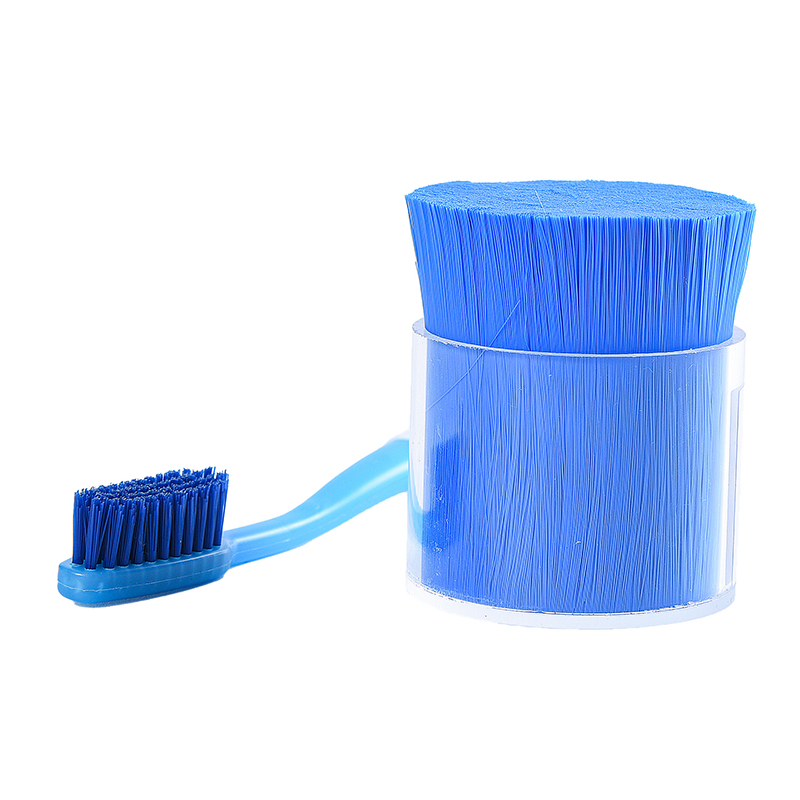 Nylon PA6 Brush Filament for Custom Brush BristlesPA6 brush filament offers customizable diameter, shape and cut length, plus SGS, ROHS and REACH certifications; useful when selecting geometry alongside resistance targets.View Product →
Stiffness, Wear and Line Speed
Two brushes in the same resistance class can behave completely differently on the same machine. Bristle diameter, free length and fill density set contact pressure, and contact pressure sets both cleaning performance and charge generation. A soft 0.10 mm bristle at 20 mm trim lightly touches a panel, removes little dust and generates little charge. A 0.30 mm bristle at 15 mm trim presses harder, cleans better and generates more static, which is why resistance class and geometry have to be chosen together.
On fast or hot lines, stiffness and heat resistance become the limit. PA66 holds more of its modulus at elevated temperature and deforms less than PA6 in continuous contact work such as conveyor cleaning, sheet handling and deburring stations. When the same tool must also cut or polish, abrasive filaments are combined with cleaning bristles rather than replacing them, because abrasion generates more charge than light sweeping does.
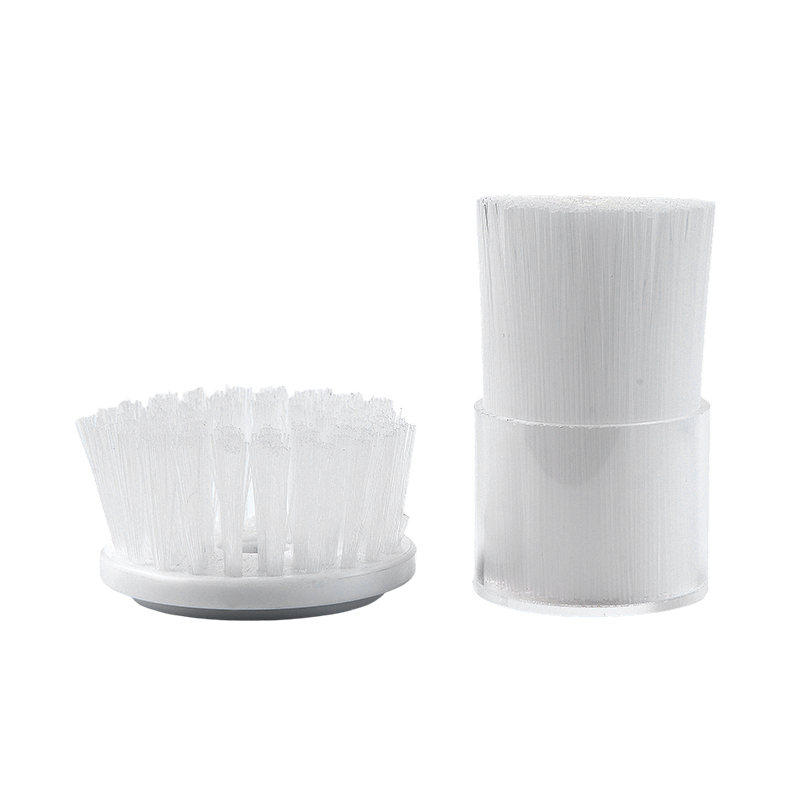 Nylon PA66 Brush Filament for High-Temperature Brush ApplicationsPA66 filament is described with high strength, toughness and chemical resistance, relevant for conveyor, deburring and polishing brushes where stiffness under heat and humidity matters.View Product →
Humidity, Cleanrooms and Dimensional Stability
Resistance is a moving target in humid air. Nylon that relies on absorbed moisture can swing several decades between a dry winter cleanroom and a humid warehouse, which makes a process window hard to hold. Carbon fiber and stainless steel fiber are less humidity sensitive than antistatic additives, but both add cost and change the feel of the bristle.
In cleanroom and precision assembly work, three properties matter at once: stable resistance, low particle shedding and low outgassing. PBT and PA612 are common answers, because they absorb very little water, hold diameter over long runs and shed fewer particles than softer nylons. Where metal contamination is a concern, carbon based fillers are usually preferred over stainless steel fiber even though steel reaches lower resistance.
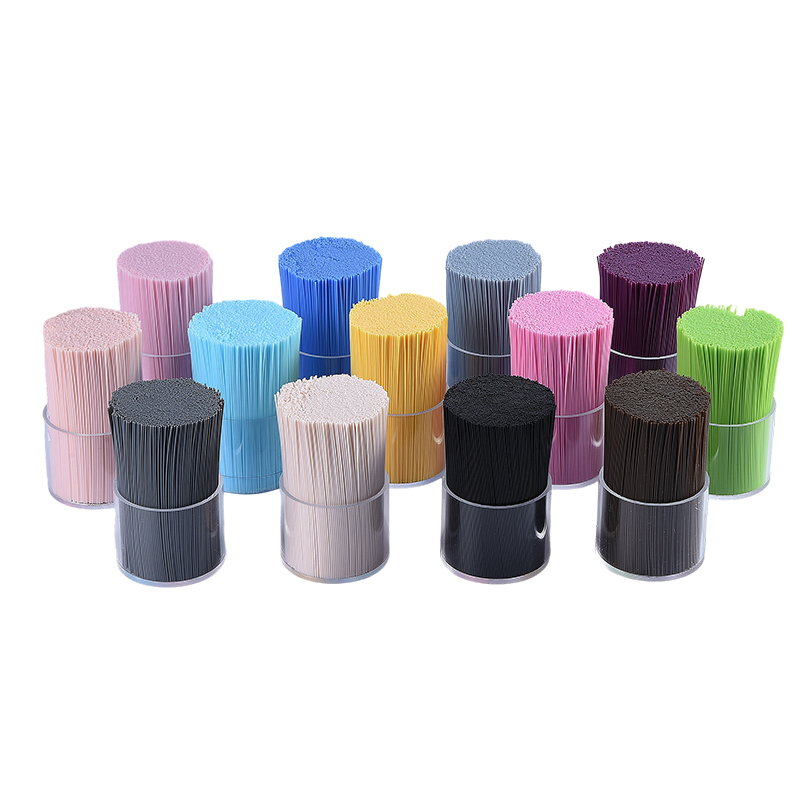 Nylon PBT Brush Filament for Cleanroom and Industrial BrushesPBT filament offers high heat resistance, rigidity and antistatic options, with SGS, ROHS and REACH certifications for precision cleaning brushes where stable dimensions matter.View Product →
Construction Details That Decide Whether the Brush Works
A filament data sheet describes the bristle only. The finished brush adds a handle, an anchoring method and an operator, and each of them can break the chain described earlier.
- Grounding continuity: measure from the bristle tips to the machine ground, not from the handle. A conductive handle with an insulating coating fails this test.
- Tuft anchoring: metal staples and ferrules usually keep a path, while epoxy potting can insulate the tuft unless a conductive grade is used.
- Fill density and trim length: these set contact pressure, which controls cleaning and charge generation at the same time.
- Tip shape: flagged or split tips hold more dust but make less contact, which reduces the charge transfer you are paying for.
- Bristle retention: loose filaments on a board or in a food line are a worse failure than a resistance value drifting half a decade.
- Storage: a brush kept in a charged plastic bag should be checked before it enters a sensitive area.
A Procurement Checklist for Anti Static Brushes
Buyers who ask for a single number tend to get the cheapest brush that meets it on paper. These steps close most of the gap between a data sheet and a working line.
- Define the class and the range, for example 10^6 to 10^8 ohm per square at 12 percent relative humidity, instead of the words anti static.
- Ask which method produced the figure, such as ASTM D257 or IEC 60093, and what temperature, humidity and settling time were used.
- Set a batch variation limit; plus or minus half a decade across shipments is a reasonable starting point for compounded filament.
- Test samples in your own environment for at least a week, including the driest and the most humid conditions the process sees.
- Confirm documentation. Suppliers exporting to Europe commonly provide RoHS and SGS reports, and food or medical contact may require more.
- Verify the ground path on the finished brush, not only on the filament sample.
- Write diameter tolerance and bristle retention into the same specification, because those properties usually fail together.
Anti static brushes fail for boring reasons: a resistance class chosen without a test method, a handle that insulates the tuft from ground, or a nylon that drifts with the weather. None of that is fixed by the word anti static on the packaging.
Work backwards from the process. Decide how fast charge builds and how sensitive the product is, choose a resistivity class, then a base polymer, then the geometry. Base polymers such as PA6, PA66 and PBT, and the compounds built on them, are the part of that chain a filament supplier controls, which is why the useful conversation with a supplier is about dispersion quality, moisture uptake, batch tolerance and abrasion data rather than one resistance figure.