
 English
 русский
 Türk
TürkContent
- 1 Why Nylon Dominates Industrial Brush Filaments
- 2 The Six Nylon Types: How They Differ and When to Use Each
- 3 Filament Diameter: The Most Consequential Physical Parameter
- 4 Chemical Resistance: Matching Filament to Process Chemistry
- 5 Temperature Range: Operating Limits for Nylon Brush Filaments
- 6 Abrasive-Loaded Nylon Filaments: When and How to Use Them
- 7 Filament Cross-Section and Tip Geometry: Beyond the Round Filament
- 8 How Operating Speed Affects Filament Selection
- 9 Regulatory and Compliance Considerations
- 10 A Practical Selection Checklist
- 11 Summary: Key Decision Points at a Glance
Selecting the right nylon brush filament is not primarily a matter of diameter or color — it starts with matching the polymer chemistry to your operating environment. The most common mistake buyers make is choosing a filament based on price or availability, then discovering it degrades under heat, absorbs moisture, or lacks the stiffness needed for the task.
The short decision rule: if your application involves fuel contact, salt spray, or continuous humidity above 60% RH, a low-moisture-absorption polyamide such as Nylon PA610 Brush Filament is the correct starting point. If the environment is dry and cost is the primary driver, PA6 or PA66 may suffice. Every other parameter — diameter, cut length, tip geometry — is secondary to this chemistry-first decision.
Why Nylon Dominates Industrial Brush Filaments
Nylon (polyamide) has been the benchmark material for synthetic brush filaments since the 1940s. Compared to natural bristle alternatives such as boar or horsehair, nylon filaments offer:
- Consistent diameter tolerance (typically ±0.01 mm on precision-drawn filaments)
- Defined and reproducible stiffness (modulus) across production batches
- Resistance to biological degradation — no mold, mildew, or insect damage
- Broad chemical resistance against oils, greases, weak acids, and solvents
- Ability to be engineered with abrasive loading (silicon carbide, alumina) for surface finishing
According to the Brush Industry Association of America, synthetic filaments now account for over 78% of industrial brush production globally, with polyamide variants representing the largest single category within that figure. The versatility of nylon chemistry — spanning PA6, PA66, PA610, PA612, and PA1010 — means that virtually every industrial condition has a corresponding filament grade.
The Six Nylon Types: How They Differ and When to Use Each
Not all nylon filaments behave the same way. The numeric suffix in each grade encodes the carbon chain length of the diamine and diacid monomers used in polymerization. Longer carbon chains produce filaments with lower moisture absorption, better chemical resistance, and higher flexibility — but also slightly lower tensile strength at room temperature.
| Grade | Moisture Absorption (23 degrees C, 50% RH) | Flexural Modulus (GPa) | Typical Use Case | Key Limitation |
| PA6 | 3.5% - 4.5% | 2.5 - 3.2 | General-purpose brushes, dry environments | Significant stiffness loss in humid conditions |
| PA66 | 2.5% - 3.5% | 2.8 - 3.5 | Higher-temperature brushing, abrasive-loaded filaments | More brittle at low temperatures vs. PA610 |
| PA610 | 1.3% - 1.8% | 1.6 - 2.2 | Marine, food processing, chemical exposure | Lower modulus than PA6/PA66 at equal diameter |
| PA612 | 1.2% - 1.6% | 1.5 - 2.0 | Precision cleaning, fine diameter brushes | Higher raw material cost than PA610 |
| PA1010 | 0.9% - 1.2% | 1.2 - 1.8 | Extreme chemical resistance, bio-based sourcing | Higher cost, limited supplier base |
| PA46 | 3.0% - 4.0% | 3.2 - 4.0 | Elevated temperature applications above 120 degrees C | High moisture absorption, requires drying before use |
Source: Data compiled from ISO 1183-1 (moisture absorption testing) and ISO 178 (flexural properties) material datasheets. Values reflect conditioned specimens at 23 degrees C, 50% RH unless noted.
Why PA610 Stands Out for Demanding Environments
Among all standard polyamide grades, PA610 offers the best balance between moisture stability and cost for industrial brush applications. Its moisture absorption of just 1.3% to 1.8% at equilibrium — compared to PA6's 3.5% to 4.5% — means that a PA610 brush filament retains approximately 85% to 92% of its dry stiffness even in continuous wet operation, whereas a PA6 filament in the same conditions may retain only 55% to 70%.
This property makes Nylon PA610 Brush Filament the preferred choice for applications such as food-grade conveyor cleaning brushes, marine deck scrubbing equipment, automotive underbody washing systems, and pharmaceutical packaging line brushes — anywhere that the brush regularly contacts water, cleaning agents, or moderate concentrations of acid or alkali.
Filament Diameter: The Most Consequential Physical Parameter
Once the base polymer is selected, filament diameter is the single most important physical specification. Stiffness (force-deflection response) scales with the fourth power of filament diameter according to Euler-Bernoulli beam theory — meaning a filament that is twice the diameter will be approximately 16 times stiffer under equivalent bending load. This relationship has enormous practical consequences.
Diameter Selection by Application Category
- 0.05 mm to 0.10 mm (50 to 100 micron): Optical component cleaning, microelectronics PCB cleaning, cosmetic brush fill. Filaments in this range have very low contact force and require densely packed configurations to generate useful cleaning action.
- 0.10 mm to 0.20 mm: Pharmaceutical equipment sealing brushes, food packaging dust removal, strip brush door seals. High filament count compensates for low individual stiffness.
- 0.20 mm to 0.40 mm: The most common industrial range. Suitable for general conveyor cleaning, parts washing, and light deburring when abrasive-loaded. PA610 in this range retains usable stiffness across a wide humidity range.
- 0.40 mm to 0.80 mm: Heavy-duty cleaning brushes, road sweeper brushes (combined with PET or polypropylene), gutter cleaning equipment. Requires high motor torque when used in power brush applications.
- 0.80 mm to 1.50 mm and above: Industrial deburring brushes, weld seam cleaning, abrasive nylon disc brushes. At this diameter, individual filaments behave more like rods than flexible fibers.
A commonly cited industry guideline (referenced in the Society of Manufacturing Engineers Brush Technology Handbook, 3rd edition) states that for optimum cleaning without substrate damage, the filament tip contact force should not exceed 0.05 N per filament in sensitive applications and may rise to 0.5 N or more for aggressive deburring. Diameter selection directly controls this parameter.
Diameter Tolerance and What It Means for Brush Performance
Mass-produced brush filaments are typically drawn to diameter tolerances of ±5% to ±8%. Precision-drawn filaments for technical applications are held to ±2% or tighter. In a brush with 10,000 individual filaments, a 5% diameter variation translates to a stiffness variation of approximately 22% across the filament population (since stiffness scales as d^4). For critical applications such as semiconductor wafer edge cleaning or precision medical device surface treatment, specifying tight diameter tolerance is not optional.
Chemical Resistance: Matching Filament to Process Chemistry
Nylon filaments are susceptible to degradation by strong mineral acids, oxidizing agents, and certain halogenated solvents. Understanding chemical compatibility is essential before finalizing a filament specification.
| Chemical Environment | PA6 | PA66 | PA610 | Notes |
| Water and aqueous solutions | Fair | Fair | Good | PA610 absorbs less, maintains stiffness better |
| Dilute acids (pH 4 to 6) | Fair | Fair | Good | Avoid extended contact with pH below 4 for all grades |
| Strong acids (HCl, H2SO4) | Poor | Poor | Poor | Consider PVDF or PPS filaments for concentrated acids |
| Alkalis (NaOH up to 10%) | Good | Good | Good | All polyamides perform well in mild alkaline wash systems |
| Aliphatic hydrocarbons (fuels, oils) | Fair | Fair | Good | PA610 has superior resistance due to longer carbon chain |
| Salt spray (marine, road salt) | Fair | Fair | Excellent | PA610 is the standard specification for marine brush applications |
| Aromatic solvents (toluene, xylene) | Poor | Poor | Poor | Use nylon with caution; PP or PVDF preferred |
| Food contact (FDA/EU compliance) | Conditional | Conditional | Good (grade-dependent) | Specify food-grade resin; request compliance certificates |
Source: Chemical resistance ratings are generalized from BASF Polyamide Chemical Resistance Guide and DuPont Engineering Polymers Filament Application Notes. Always test in actual process conditions before finalizing specification.
For processes involving food contact, Nylon PA610 Brush Filament produced from food-grade resin and verified against EU Regulation No. 10/2011 or FDA 21 CFR 177.1500 provides a safe, compliant option for bakery equipment, fruit and vegetable sorting lines, and meat processing conveyor brushes.
Temperature Range: Operating Limits for Nylon Brush Filaments
Nylon filaments are thermoplastic materials, meaning their mechanical properties change with temperature. This is particularly important for brushes used near ovens, autoclave washers, or in environments with significant seasonal temperature variation.
- PA6 and PA66 continuous service limit: 80 degrees C to 105 degrees C (dry), dropping to approximately 60 degrees C to 70 degrees C in wet or humid environments due to plasticization by absorbed moisture.
- PA610 continuous service limit: 80 degrees C to 100 degrees C (dry), but retains a higher percentage of its stiffness in wet heat compared to PA6/PA66 due to lower moisture uptake.
- Low-temperature performance: At temperatures below -10 degrees C, PA6 and PA66 filaments become noticeably more brittle. PA610 and PA612 maintain better impact resistance at sub-zero temperatures, making them preferred for cold-store cleaning equipment and outdoor winter brush applications.
- Short-term peak temperature: Most nylon filaments can withstand intermittent exposure to 130 degrees C to 150 degrees C without permanent set, but repeated cycling above the continuous limit causes accelerated stress relaxation and reduced filament return force.
For applications above 130 degrees C continuous, consider PEEK, PPS, or high-temperature nylon (PA46) filaments instead of standard grades. Below 60 degrees C in dry environments, any of the standard polyamide grades will perform reliably with correct diameter selection.
Abrasive-Loaded Nylon Filaments: When and How to Use Them
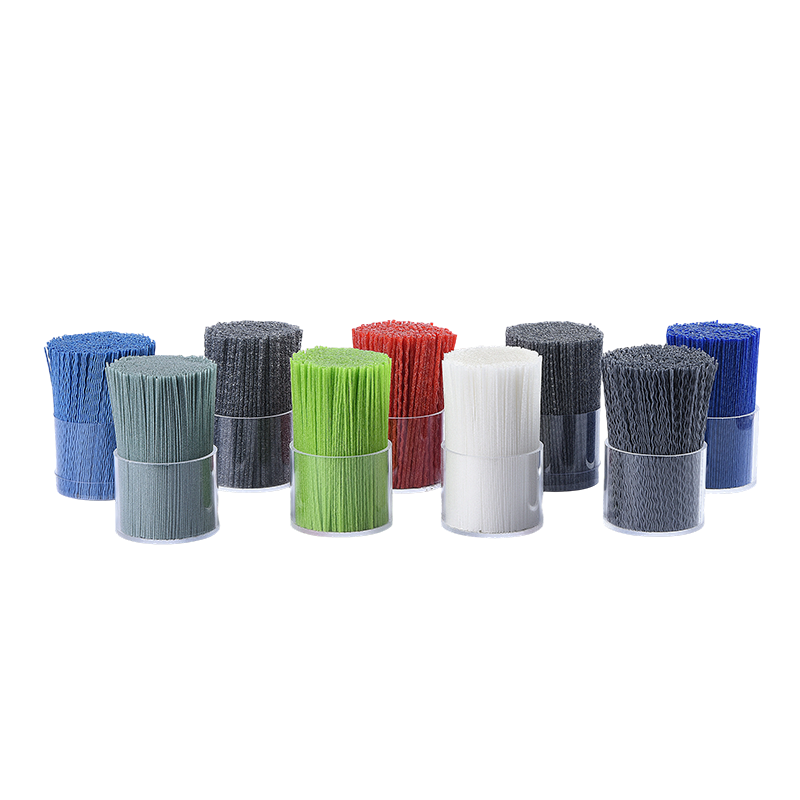
Abrasive nylon filaments are produced by compounding mineral abrasive particles — most commonly silicon carbide (SiC), aluminum oxide (Al2O3), or diamond dust — into the nylon matrix during extrusion. The result is a filament that acts simultaneously as a brush element and a cutting tool, with abrasive particles continuously exposed at the tip as the filament wears.
Abrasive Grade and Grit Selection
- Silicon carbide (SiC) filaments: The most aggressive cutting action. Available in grit sizes from 46 to 1000 (coarser numbers = coarser cut). Used for deburring cast aluminum, removing weld flash, and surface preparation before coating. PA66 is the most common carrier polymer due to its higher modulus supporting the SiC load.
- Aluminum oxide (Al2O3) filaments: Milder cutting action than SiC, better suited for ferrous metals where SiC may cause contamination. Widely used in aerospace component surface finishing.
- Diamond-loaded filaments: Reserved for hard materials — ceramics, carbide tooling, glass. Very high cost; used only where other abrasives cannot achieve the required result.
Abrasive Loading Level and Its Effect
Standard abrasive nylon filaments contain 20% to 40% by weight of abrasive mineral, which directly reduces the tensile strength and elongation of the carrier filament. A 30% SiC-loaded PA66 filament will have approximately 35% to 45% lower elongation at break than an unfilled PA66 filament of the same diameter. This means abrasive filaments are more prone to breakage under high contact pressure and should not be operated at deflection ratios greater than 30% of free length (compared to up to 50% for unfilled filaments). Source: 3M Abrasive Nylon Filament Technical Data Sheet, Product Engineering Bulletin 7010-3765.).
Filament Cross-Section and Tip Geometry: Beyond the Round Filament
While round-cross-section filaments represent the vast majority of industrial brush fill, alternative geometries are available and provide performance advantages in specific applications.
- Crimped or corrugated filaments: Mechanical crimping along the filament length increases bulk fill density and creates more contact points per unit area. Particularly effective in strip brushes used for sealing and wiping applications where full surface contact is more important than penetration depth.
- Flag-tipped filaments: The tips are mechanically split or chemically etched to create a fine, multi-strand tip. Widely used in paint brushes and cosmetic brushes where smooth paint release or fine detail application is required. Less common in industrial applications.
- Tapered filaments: Diameter decreases toward the tip, creating a more flexible working end with a stiffer base. Used in artist brushes and high-end cosmetic applications.
- Hollow filaments: Can carry and release liquids during brushing — used in specialty marking, lubrication delivery, and chemical application brushes.
For most industrial cleaning, sealing, and light deburring applications, solid round filaments remain the best-performing and most cost-effective option. Modified geometries typically add 20% to 60% to filament cost and should be specified only when the application data supports the premium.
How Operating Speed Affects Filament Selection
When a brush rotates or reciprocates, the centrifugal force acting on each filament adds to the effective stiffness and changes the contact dynamics. For power brushes operating above 1,000 RPM, this effect is significant and must be incorporated into filament selection.
A practical formula used in brush engineering (referenced in the Finishing Technology Handbook, published by the Metal Finishing Industry Association) states that the centrifugal stiffening coefficient increases approximately as the square of the peripheral velocity. At 3,000 RPM with a 150 mm brush diameter, peripheral speed approaches 23.5 m/s — a point at which even a relatively soft PA610 filament of 0.3 mm diameter will exhibit markedly stiffer effective contact behavior than at rest.
The practical implication: for high-speed power brushes, select filaments one diameter range smaller than you would for manual or slow-speed applications performing the same surface work. Oversized filaments in high-speed brushes cause surface damage, excessive heat generation, and rapid fatigue failure at the filament root.
Filament Length and Deflection Ratio
Free filament length — the unsupported length from the brush body to the tip — is as important as diameter in determining contact force. Industry practice defines the working deflection ratio as the amount of tip deflection relative to free filament length. Recommended operating deflection ratios are:
- Gentle cleaning and wiping: 10% to 20% deflection
- Standard industrial cleaning: 20% to 35% deflection
- Aggressive deburring and surface treatment: 35% to 50% deflection
- Above 50%: Risk of permanent set, root fatigue cracking, and premature filament loss — not recommended for continuous operation
Regulatory and Compliance Considerations
In regulated industries, the compliance status of the brush filament material is not optional documentation. Key compliance frameworks relevant to nylon brush filaments include:
- Food contact: EU Regulation No. 10/2011 on plastic materials for food contact, or FDA 21 CFR 177.1500 (nylon resins) for the US market. Filament manufacturers should provide a Declaration of Compliance or migration test certificate for each lot.
- RoHS and REACH: Confirm that pigments, lubricants, and additives in the filament compound do not contain restricted substances under EU REACH Annex XVII or RoHS Directive 2011/65/EU. Particularly relevant for brushes used in electronic assembly equipment.
- USDA and NSF certification: For agricultural processing and food equipment in North America, NSF/ANSI 51 (Food Equipment Materials) or USDA approval of brush components may be required.
- Antistatic specifications: In explosive atmospheres (ATEX zones) or semiconductor cleanrooms (ISO Class 5 and above), filaments must meet defined surface resistivity limits — typically below 10^9 ohms/sq for antistatic grades, below 10^6 ohms/sq for conductive grades.
When sourcing Nylon PA610 Brush Filament for food or pharmaceutical applications, always request material compliance documentation and lot traceability records from the manufacturer as a standard part of the procurement process.
A Practical Selection Checklist
Before placing a filament order, confirm the following parameters in writing:
- Base polymer grade (PA6 / PA66 / PA610 / PA612 / other) and whether a food-grade or specialty compound is required
- Filament diameter and acceptable tolerance (specify ±% or absolute ±mm)
- Free filament length and intended deflection ratio in service
- Operating temperature range (minimum and maximum, wet and dry conditions)
- Chemical exposure list (cleaning agents, process fluids, lubricants) and required resistance level
- Abrasive loading requirement — grit type, grit size, loading percentage — if applicable
- Regulatory compliance requirements (FDA, EU 10/2011, REACH, antistatic, etc.)
- Quantity, packaging format, and lead time
- Testing and quality documentation required (material certificate, compliance declaration, dimensional report)
Completing this checklist before engaging a supplier eliminates the most common source of filament misspecification — choosing a material based on partial information and discovering the mismatch only after the brush has been manufactured and installed.
Summary: Key Decision Points at a Glance
| Decision Point | Key Factor | Recommended Action |
| Polymer grade | Moisture, chemical, temperature exposure | Use PA610 for wet or chemically challenging environments; PA6/PA66 for dry general use |
| Filament diameter | Required contact force and substrate sensitivity | Apply beam theory (d^4 stiffness scaling); size down for high-speed brushes |
| Chemical resistance | Process fluid compatibility | Cross-reference against published chemical resistance data; test in actual conditions |
| Abrasive loading | Surface removal requirement | Specify grit type and size; limit deflection to max 30% for abrasive filaments |
| Compliance | Regulatory environment of end use | Confirm FDA / EU 10/2011 / REACH status; obtain compliance certificates |
| Operating speed | RPM and peripheral velocity | Account for centrifugal stiffening; maintain deflection within recommended ratio |