
 English
 русский
 Türk
Content
Static is an invisible defect with a visible price. It pulls dust onto a freshly printed web, makes film cling to a roller, shocks an operator at a powder chute, and leaves a board that fails an ESD audit long after it left the line. A brush is usually the cheapest fix, and it is also the most commonly mis-specified part on the machine.
The short version before the detail: the antistatic behaviour of a brush is decided in the filament, not in the brush. What counts is the polymer the filament is drawn from, the conductive additive compounded into it, the resistance band the grade is built for, and whether the finished brush gives that filament a real path to ground.
Antistatic, Dissipative and Conductive Are Three Different Things
Buyers use antistatic as a catch-all word. ESD engineers do not, because the word hides a number. Most electronics and powder handling programs follow IEC 61340-5-1 or ANSI/ESD S20.20 and classify materials by measured resistance instead.
| Class | Resistance | Where it fits |
|---|---|---|
| Insulating | Above 10^12 ohms | Unfilled nylon or PBT. Strong wear, no static control, charge stays where it was generated. |
| Static dissipative | 10^4 to 10^11 ohms | Electronics, board handling, clean surfaces. Charge bleeds off slowly enough to avoid a spark. |
| Conductive | Below 10^4 ohms | Webs, powders and dust atmospheres where charge builds fast and bleed-off must be quick. |
Two consequences follow. Loose filament and a finished brush do not measure the same, because tuft density and contact pressure create parallel paths, so a grade that reads dissipative as a strand can read conductive in a dense brush on a grounded metal channel. Resistance also moves with moisture. Nylon takes water from the air, absorbed water lowers resistance, and a grade approved in a humid month can drift upward in a dry, heated plant in winter.
How a Conductive Brush Filament Is Made
Antistatic filament is not a nylon bristle dipped in a conductive coating. That approach is the one to avoid on any line that wears or washes, because once the coating is gone the brush quietly becomes an insulator. The durable route is compounding: conductive particles are mixed into the polymer melt, extruded, drawn to the final diameter and cut to length, so the conductive network runs through the whole cross section.
The base polymer sets the mechanical limits
PA6 is the workhorse carrier: tough, tolerant of continuous bending and easy to compound, which is why it appears in a large share of general purpose antistatic grades. Its weakness is moisture, so resistance and dimensions both shift with the seasons.
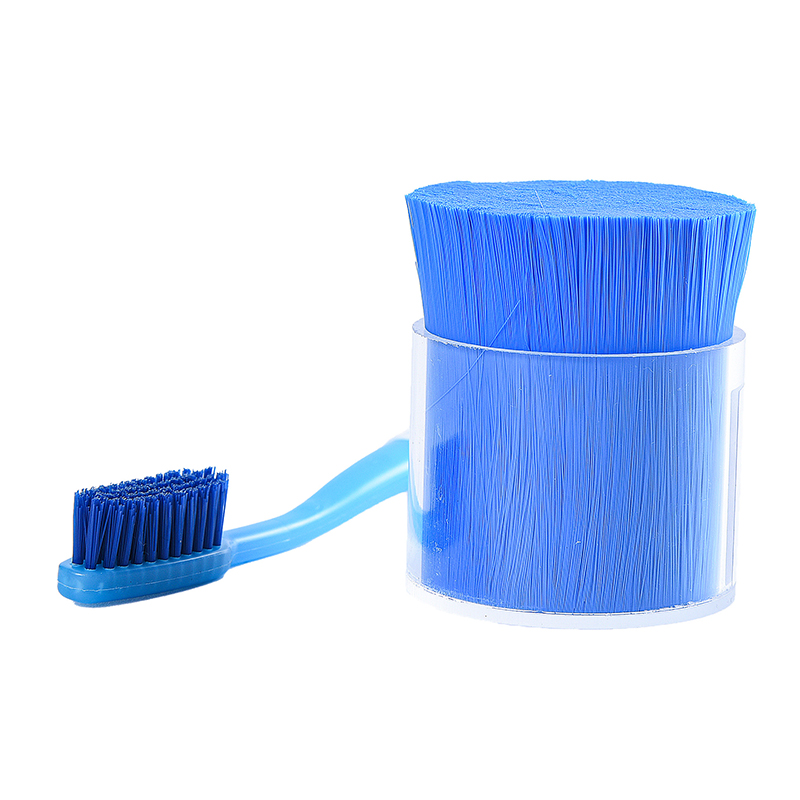 Nylon PA6 Brush Filament for General-Purpose BrushesTough, bend-tolerant PA6 monofilament for general brushes; consider it where moisture shifts are manageable and PA66's higher stiffness or heat resistance is not required.View Product →
PA66 behaves similarly in a brush but holds stiffness and heat resistance better, which matters when the brush runs warm or when bristle set becomes a problem at high deflection.
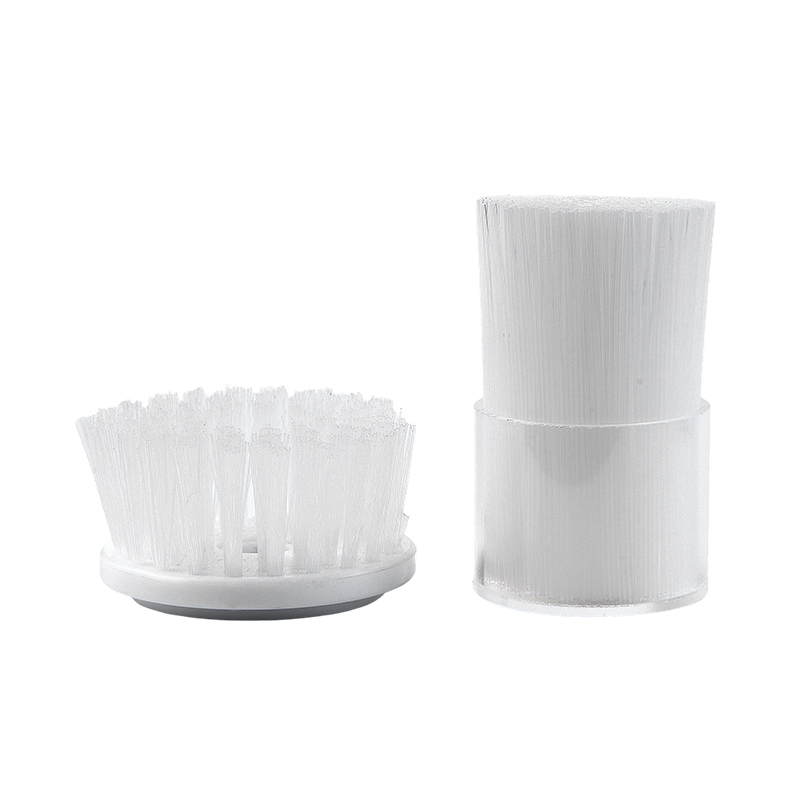 Nylon PA66 Brush Filament for Higher Stiffness and HeatStiffer, more heat-resistant PA66 monofilament for warm or highly deflected brushes; consider it before PA610 or PA612 when moisture stability is less critical.View Product →
PA610 and PA612 sit between the two on moisture uptake and are worth considering when a line needs more dimensional stability than PA6 without moving to a specialty polymer.
PBT is the choice when stability matters more than flex life. It absorbs very little water, so resistance and cut length hold steady across humidity changes, and it resists many oils and solvents better than unfilled nylon. It is stiffer, so it suits short trim and light contact rather than long, heavily deflected tufts.
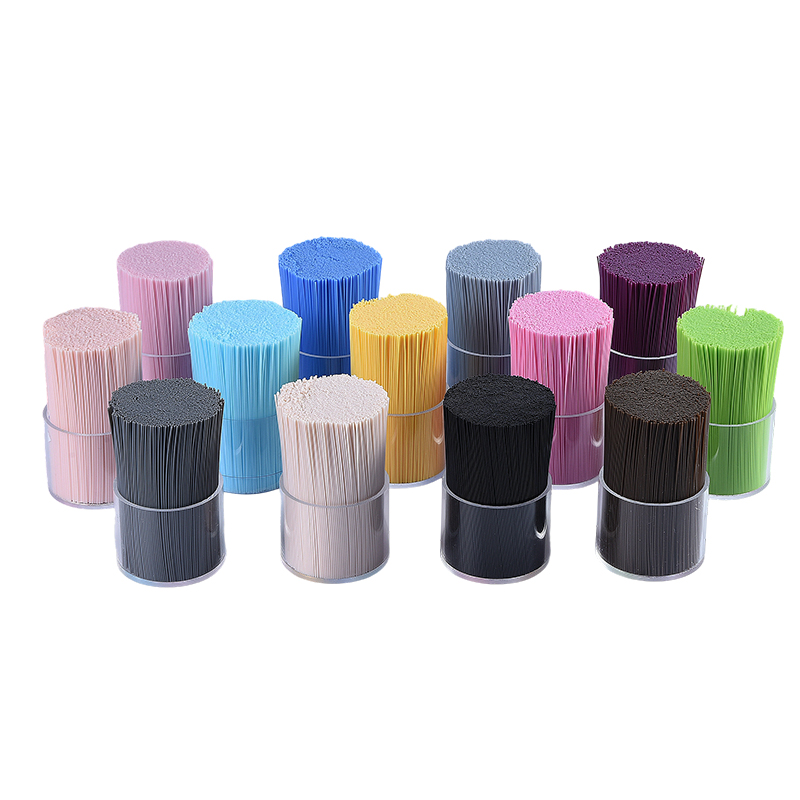 Nylon PBT Brush Filament for Stable, Heat-Resistant BristlesLow-moisture PBT monofilament that holds cut length and resistance across humidity, suited to short, lightly loaded trim and heat-exposed cleaning brushes.View Product →
The additive decides the resistance band
Three families dominate. Carbon black is the cheapest route to dissipative and conductive grades, and its dispersion quality is where lot-to-lot drift begins. Carbon fibre and nanotubes reach a target resistance at lower loading and protect mechanical properties better at a higher price. Metal coated options reach very low resistance but add cost, corrosion risk and particle shedding.
Lower resistance always costs something mechanically. Higher additive loading reduces tensile strength and elongation, makes tips more likely to snap into contamination, and wears extrusion dies faster. Colour is the visible trade-off: carbon loaded grades are black, so a light coloured or metal detectable brush needs a different conductive system and a fresh measurement.
Matching the Grade to the Application
Electronics and PCB handling
Boards, panels and connectors are normally handled with dissipative brushes in the 10^6 to 10^9 ohm range on grounded frames. Staying dissipative rather than conductive is a safety decision, because a low resistance brush touching a live circuit can carry current where it should not. Particle shedding belongs in the specification too, since a broken conductive tip on an assembled board is both a contamination defect and a short circuit risk.
Powder, grain and bulk solids
Conveyor skirts, chutes and hopper outlets generate charge quickly when dry powder slides past. This is where resistance control matters most, because a discharge in a dust atmosphere is an ignition source, and it is also where the grounding path is most often the weak link. Conductive filament helps only if the holder, mounting and frame are bonded to earth and that bond is checked on a schedule.
Film, foil and web converting
Brushing a moving web just before the winder is one of the cheapest ways to cut blocking, dust attraction and streaks. Dissipative grades are normal here, with fine filaments and light contact pressure so the brush neutralises without scratching. Diameter, tip form and tuft density matter as much as the resistance band.
What Belongs in a Filament Specification
An order that says only antistatic nylon filament, 0.20 mm, black leaves the supplier to decide everything that matters. A workable specification names the following.
- Target resistance band as a range, plus the test method to be used.
- Test conditions: temperature, relative humidity and conditioning time before measurement.
- Diameter with tolerance, usually quoted in hundredths of a millimetre, because tuft fit and pull-out strength depend on it.
- Cut length and tip treatment, especially on brushes that must not mark the surface they touch.
- Mechanical values or an agreed deflection test, plus service temperature and resistance to the oils and cleaners the brush will meet.
- Lot documentation: a certificate of analysis with the measured resistance, the method and the date.
The largest procurement risk is buying on price per kilogram and leaving the resistance band unstated. Two filaments can look identical and cut the same while one holds a dissipative range for years and the other drifts out of it within weeks. The second risk is trusting the word antistatic on a data sheet and never asking for the number behind it.
Why Antistatic Brushes Fail in the Field
- No path to ground. Conductive filament in an insulating plastic holder, or in a metal channel never bonded to earth, dissipates nothing.
- Coated bristles. A surface treated filament works when new and stops working once the coating wears or is washed away.
- Wrong band. A dissipative brush where fast bleed-off is needed, or a conductive brush pressed against live electronics.
- Contamination. Oil mist, dust and release agents build an insulating film on the tufts and resistance climbs unnoticed.
- Humidity assumptions. A grade approved at 23 degrees Celsius and 50 percent relative humidity can read very differently in a dry winter plant.
None of these failures comes from the polymer alone. An antistatic brush is a system of filament, holder, mounting, grounding and cleaning interval, and it performs only when all five are specified together.
Sourcing the Filament, Not Just the Brush
Most quality problems with antistatic brushes are decided before the brush exists, at the filament supplier. A maker that compounds, extrudes and draws in house controls carbon dispersion, diameter tolerance and cut length, and can explain which resistance band a grade was formulated for. Documented examples of how conductive grades behave in real equipment are collected in this note on conductive plastic brush filaments, and the carriers those grades are built on are listed in the brush filament product range.
Ningbo Keying New Material Technology supplies filament rather than finished brushes, and develops grades against a customer drawing or sample, which is the practical route when no standard product hits the required band. A sensible sequence is to measure the resistance you actually need on the line, choose the base polymer from the working conditions, confirm the grade on a sample brush at real humidity, then lock the specification and the lot certificate.
Antistatic brushes do one simple job: move charge from a surface to earth without sparking and without damaging what they touch. The decisions that make that happen are made in the filament, in the resistance band selected, the polymer carrying the additive, and the grounding path the finished brush provides. Get those right and the brush is a low cost fix. Leave any of them to chance and the same brush becomes an insulator that looks exactly like the part it replaced.