
 English
 русский
 Türk
TürkContent
- 1 Why Neat PLA Reads as an Insulator
- 2 Which Filler Gets You Which Resistivity Range
- 3 Percolation Is a Step Change, Not a Dial
- 4 Why PLA Is Harder to Functionalize Than PBT or PA6
- 5 Measuring Resistivity So the Number Means Something
- 6 From a Lab Compound to a Production Filament
- 7 What to Put in the Specification Before You Order
Three spools of polylactic acid filament, all extruded on the same machine on the same afternoon, came back from the lab at 1E7, 1E9 and 1E12 ohms per square. The formulation had not changed. The drying time and the screw speed had.
That gap is the short answer to most questions about functionalizing PLA for electrical resistivity. The additive decides which order of magnitude you can reach. Drying, compounding, drawing and conditioning decide whether you stay there. Functionalizing PLA means giving an insulating polyester a path for charge to travel, either through a connected network of conductive particles or through chemical groups that carry ions. Both routes work in a lab dish. Only one of them reliably survives extrusion into a 0.2 mm filament.
Why Neat PLA Reads as an Insulator
Neat PLA behaves like most thermoplastics. Published volume resistivity sits around 1E15 to 1E16 ohm-cm, and surface resistivity falls in the same range. There are no free electrons and no mobile ions, so charge has nowhere to go.
The additive route builds a percolating network of conductive particles: carbon black, carbon nanotubes, graphene, graphite or short carbon fibers. It is the only route that reaches genuinely conductive values, from roughly 1E3 to 1E9 ohms per square depending on the system and the loading.
The chemical route modifies the polymer itself. Grafting polar groups onto the backbone, copolymerizing with polyethylene glycol, or blending in an intrinsically conductive polymer such as PEDOT:PSS raises ionic conductivity and pulls surface resistivity down by two to three orders of magnitude. It rarely reaches the conductive range on its own, and ionic conduction depends on moisture, which is a poor fit for a dry electronics assembly area.
For filament work, the additive route does the heavy lifting. Chemical modification is usually a supporting act.
Which Filler Gets You Which Resistivity Range
Start with the filler family that matches the target band, then spend your development time on dispersion. Table 1 sets out the ranges seen in practice.
| Filler system | Typical loading | Surface resistivity reached | Main trade-off |
|---|---|---|---|
| Carbon black | 5 to 15 percent | 1E3 to 1E6 ohms per square | High loading, brittle filament, high melt viscosity |
| Carbon nanotubes | 0.5 to 3 percent | 1E5 to 1E9 ohms per square | Cost, sensitivity to over-shearing |
| Graphene | 1 to 5 percent | 1E4 to 1E8 ohms per square | Platelet orientation follows the draw ratio |
| Carbon fiber | 10 to 20 percent | 1E2 to 1E6 ohms per square | Coarse particles, die wear, limits fine diameters |
| Ionic antistatic agent | 1 to 3 percent | 1E9 to 1E11 ohms per square | Humidity dependent, can migrate to the surface |
| Conductive polymer blend | 3 to 10 percent | 1E7 to 1E10 ohms per square | Moisture sensitive, limited thermal stability |
| Nanotube plus ionic liquid | 1 to 4 percent | 1E6 to 1E9 ohms per square | More stable network, more complex compounding |
Abrasive filament uses the same compounding logic with a different functional filler. There the filler is a hard mineral particle and the target property is cut rate rather than resistivity, but the questions about dispersion, loading, draw ratio and die wear are identical.
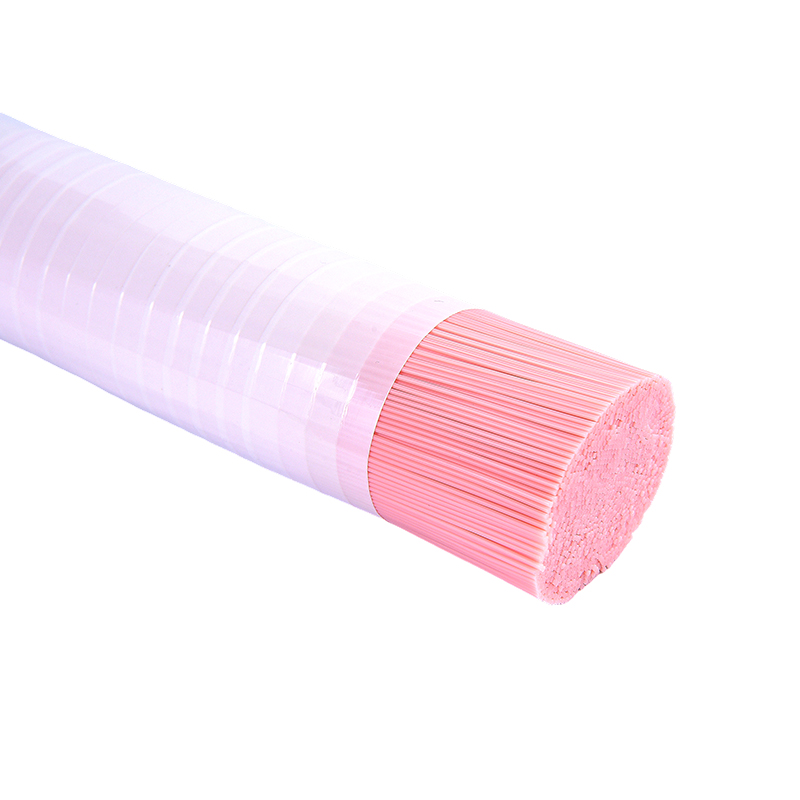 Abrasive Nylon Brush Filament for Metal Deburring and Surface FinishingFor readers comparing functional fillers and cut-rate performance, this abrasive filament range details loading, grit, and nylon grades.View Product →
Percolation Is a Step Change, Not a Dial
The curve of resistivity against filler content is nearly flat, then falls off a cliff. At the percolation threshold, resistivity can drop five to eight orders of magnitude within one or two weight percent of filler. That shape has practical consequences.
- Weighing accuracy on the masterbatch becomes a quality parameter, not a housekeeping detail.
- Aspect ratio matters. A nanotube with an aspect ratio in the hundreds percolates at a fraction of the loading needed for spherical carbon black, but it also breaks under excessive shear, and broken tubes raise resistivity.
- Annealing above the glass transition temperature, roughly 55 to 60 degrees C for PLA, lets the network rearrange, so resistivity can drift after a heat cycle.
- Service temperature becomes a limit. A part that reads 1E8 at 23 degrees C can read 1E11 after an hour at 60 degrees C.
Why PLA Is Harder to Functionalize Than PBT or PA6
Drying is not optional
PLA hydrolyzes. Moisture in the pellet breaks ester bonds during melting, molecular weight falls, melt viscosity drops, and the filament turns brittle. Dry to below 250 ppm, typically four hours at 80 degrees C in a desiccant dryer, and keep the material covered afterwards. A wet batch changes the mechanical result and the electrical one, because molecular weight changes how the filler network forms.
The thermal window is narrow
PLA melts near 170 to 180 degrees C and processes between roughly 190 and 220 degrees C. Above 230 degrees C it degrades. High surface area fillers raise melt viscosity and screw torque, which pushes the melt temperature up exactly when there is no headroom. Short residence time, a gentle screw profile and a well-dispersed masterbatch matter more here than in a polyolefin.
Crystallinity and draw ratio
Grade selection changes the outcome. A higher D-lactide content gives a more amorphous polymer that draws more easily but softens earlier. Crystallization pushes filler out of the growing spherulites and into the amorphous regions, concentrating the network locally, and some of the scatter in published PLA resistivity data comes from exactly that. Drawing orients the chains and stretches the network along the axis, so axial resistivity can fall while transverse resistivity rises. Two labs can test the same spool and report different numbers simply because they measured in different directions.
When a part has to run warm or sit in humid air, PBT is often the more forgiving matrix, and the same compounding rules apply.
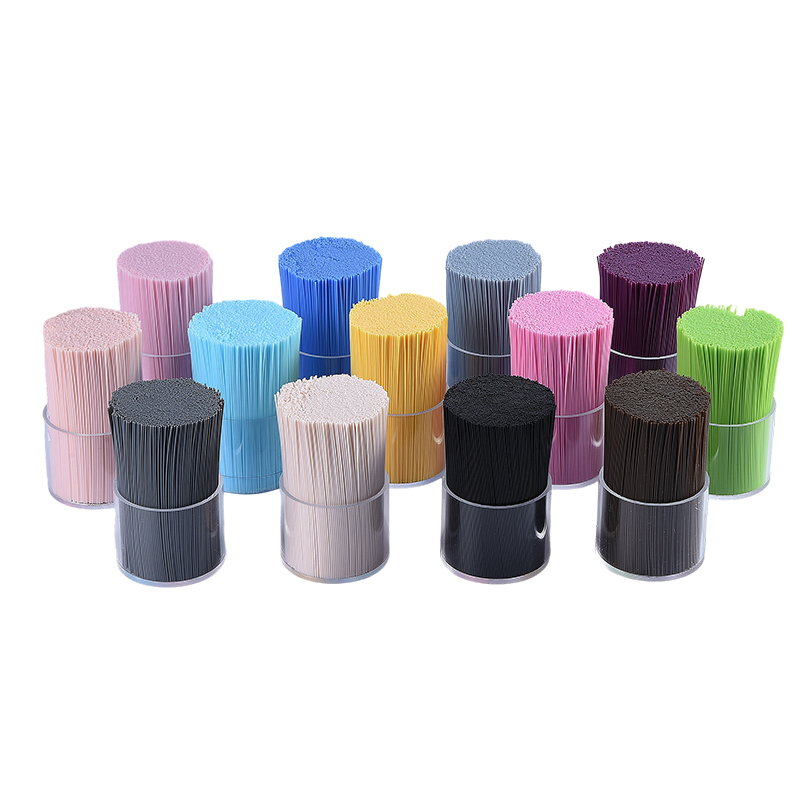 Nylon PBT Brush Filament for Heat-Resistant and Antistatic BristlesPBT/nylon bristle material for warm or humid service, offering heat resistance, insulation, antistatic options, and custom shapes for brush manufacturing.View Product →
Measuring Resistivity So the Number Means Something
A resistivity value without a method is not a specification. Report the standard, the conditioning and the electrode geometry every time. ASTM D257 and IEC 62631-3-1 cover volume resistivity, IEC 62631-3-2 covers surface resistivity, ASTM D4496 covers dissipative materials, and IEC 61340-5-1 applies when the part sits inside an ESD control program. Condition to ASTM D618 at 23 degrees C and 50 percent relative humidity for 40 hours before testing.
- Use 60 seconds of electrification for anything above 1E6 ohms. Shorter times read low.
- Use a guarded ring electrode for surface measurements, and four-wire sensing below 1E5 ohms where lead resistance starts to matter.
- Paint the contacts with silver, or contact resistance becomes part of the reading.
- State whether the target is surface or volume resistivity. They are different quantities, and ohms per square is not the same as ohm-cm.
- Test after any annealing step the part will see, and test at the service temperature if the part runs warm.
From a Lab Compound to a Production Filament
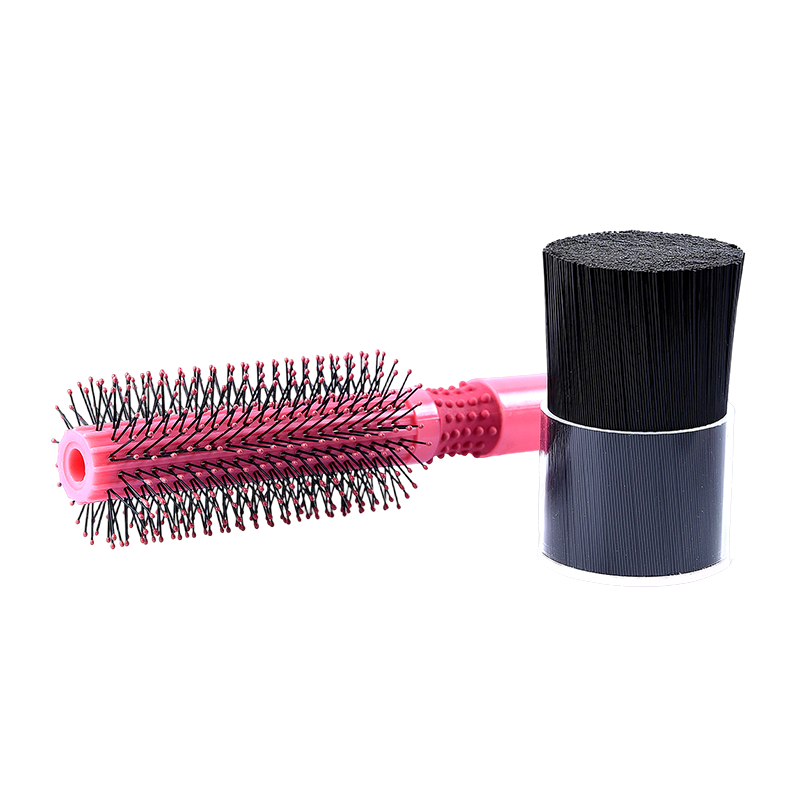
Everything above is compounding logic, and it is the same logic that runs a monofilament line. A brush filament is a compounded polymer with a diameter between about 0.1 and 2 mm, so the variables that decide the result are dispersion, drying, draw ratio and cooling, not chemistry alone.
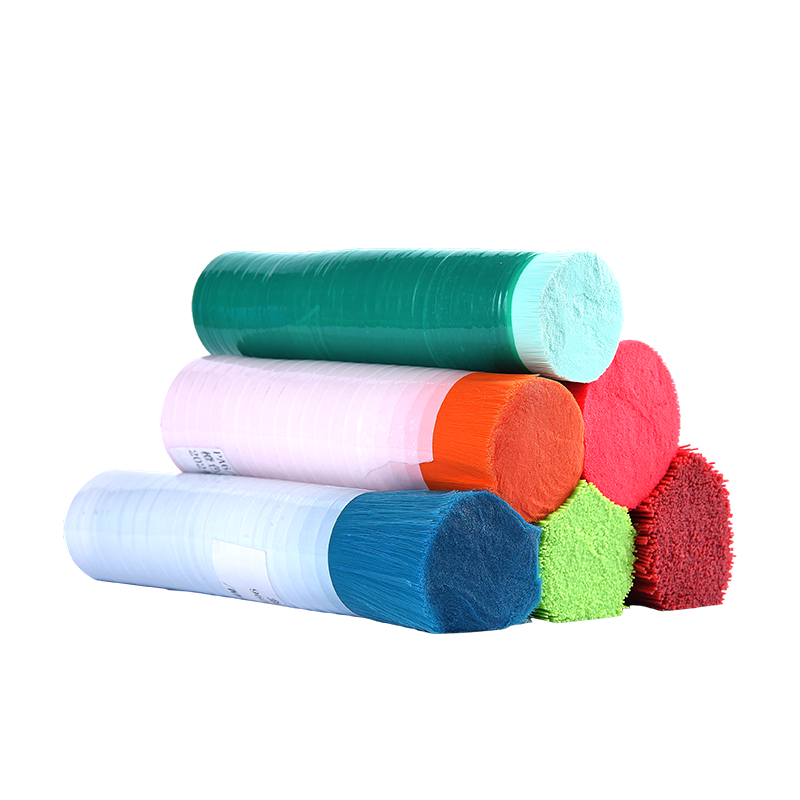
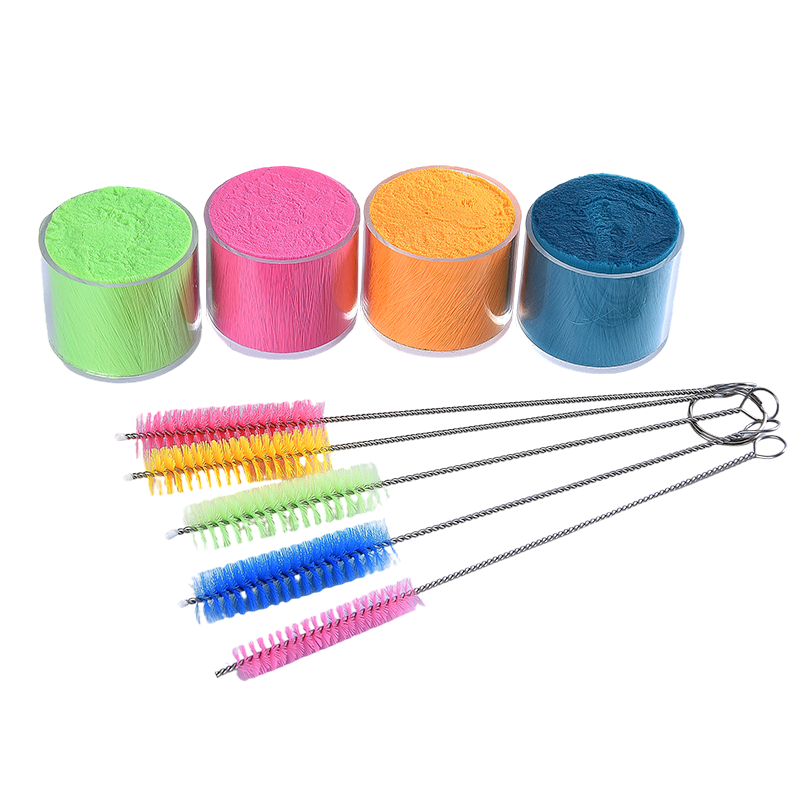
That is the working knowledge behind the filament range at Ningbo Keying New Material Technology: nylon PA6, PA66, PA610, PA612, PBT and abrasive filaments, produced on four imported lines with an annual capacity above 1,000 tons in a plant of more than 7,000 square meters. The company has been developing and manufacturing filament since 2010 and builds custom grades from customer drawings or samples, with RoHS and SGS compliance as the export baseline. When the application is static dissipation rather than structure, the same questions apply to filaments made for conductive plastic brush filaments used in electronics handling.
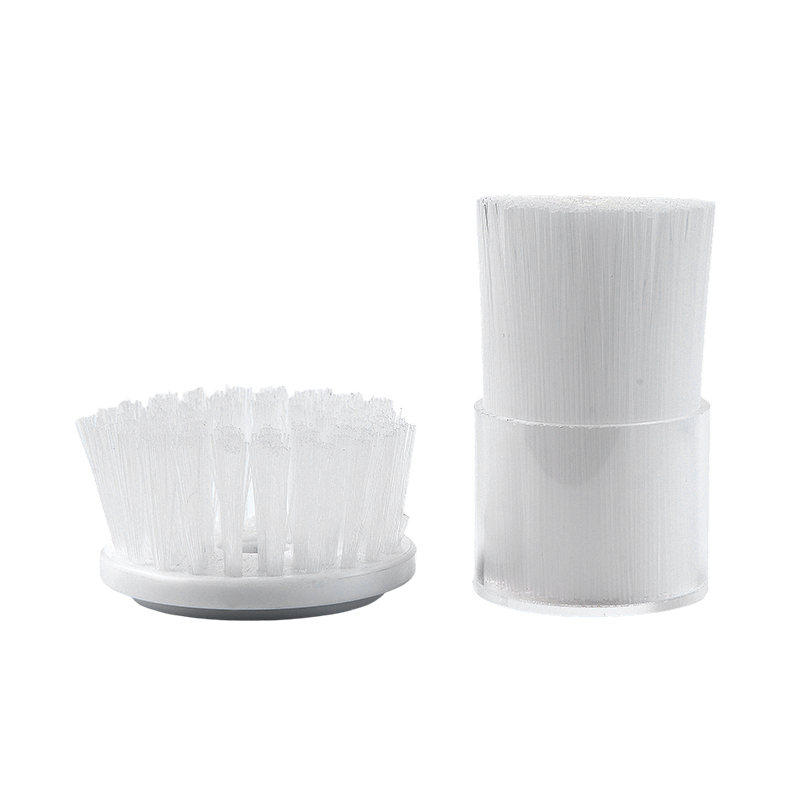 Nylon PA66 Brush Filament for Cleaning, Deburring, and PolishingFrom a filament maker with custom grades and RoHS/SGS baseline, this PA66 bristle suits cleaning, deburring, and polishing brushes.View Product →
What to Put in the Specification Before You Order
The order of the items matters less than having all of them in one document.
- Target surface resistivity and volume resistivity, each with the test standard, conditioning routine and electrification time.
- The acceptable band, expressed on a log scale. Half a decade either side of target is realistic for a filled compound; a plus or minus 10 percent band is not.
- Service temperature and humidity, including short term peaks during assembly or cleaning.
- Diameter, ovality and length tolerance, with the measurement method named.
- Drying instructions and the recommended processing window, in writing.
- Whether the conductive property sits in the bulk or in a coating, because a coating can be rubbed off.
- Lot to lot acceptance testing, including who pays for the retest when a lot misses the band.
Resistivity in PLA is a process property as much as a formulation property. Pick the filler family that matches the target band, dry the resin properly, keep the melt below the degradation limit, measure with a stated method, and the numbers will repeat. Skip any one of those steps and the next spool will read differently from the last.